 I am not a creative person. At least that's what I've been telling myself my whole life. I don't draw well, paint, color. I don't quite know how to decorate my house. I don't have a vision for my gardens - in fact, I hate gardening - love looking, hate gardening. I don't even wrap presents well. Gift bags were the greatest invention ever!
But lately, I've been coming up with ideas and I'm starting to think that this is my creativity. I am an idea person. I don't always know how to implement these ideas but I have many. Of course, they all seem to center around teaching. That is, after all, where my brain seems to be most focused. And one of the great things about teaching is, I don't do it alone. I might not know how to get it going, but I know who to turn to for help.
 Case in point:
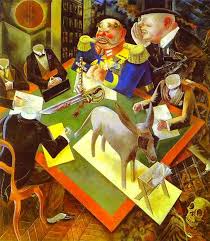
Yesterday, my class took a trip with the art teacher, Maria Monda, to the Heckscher Museum in Huntington. This is a trip we take each year and, therefore, we see the same paintings in the collection each year. One of them is George Grosz' Eclipse of the Sun. This painting was done during the Symbolism period in the 1920's. The museum liaison spends time with the kids picking out the symbols in the painting. While the kids were listening, I had a brainstorm. The creative me came out and turned to Maria, saying, "Why don't we do that with the kids? Make a symbolic picture?" We talked later about it and now I have just finished planning the project. I am introducing symbolism in poetry and literature. Then we will discuss social issues we face today. Kids will chose one and work with the art teacher in the computer lab creating a symbolic picture about their chosen issue.
Point 2:
 Our science program is in the process of being completely revamped. What that means for me is I was given about 16 more weeks of science to teach. Go ahead...ask me if anything was removed. I know you know the answer to that one. So, as a result, for the first time in 25 years of teaching, I feel it is literally impossible to teach all of my curriculum. At first, my solution was to complain...to my co-teacher, to my husband, to my science coordinator, to my principal, to my union reps. Guess where that got me. Exactly. So I went back to my science coordinator, Sharon Judge. You should know Sharon is the new science coordinator. She has been a classroom teacher in the district as long as I have so we have a history together. This makes it so much easier to work with her. Back to our meeting. She spent time telling me she would help me out in any way she could but I still needed to cover everything. I looked and looked at the list of topics and a brainstorm hit! Four of the units are about energy: light, natural resources, simple machines, and plant tropisms. So Sharon and I began to talk about my idea. Next year, I am going to teach one large unit on energy. Children will work in groups on different topics and create....not sure yet. But when all is done, they will know about energy through simple machines, plants, light, natural resources, and then some. PBL comes into play and I will have 16 weeks worth of science done in about 6. Voila!
Point 3:
 I have two chapters to cover in social studies before I can move on to my next project. It is the only time of the year the social studies textbooks come out. These two chapters are so full of information that it would take too long to teach each event one at a time. So we use the books. It lays the groundwork for our Westward Expansion project. Last year we had the idea of using CoverItLive to engage the students in the textbook. It worked well but I really wanted to get away from direct instruction this year. So Christine and I talked and, you got it, brainstorm! We took all the topics in the two chapters, broke them into four main categories: politics, geography, people, and events. We then made four groups of 6, with each student responsible for researching one topic in a category. Once the research is complete, the larger group of 6 will be creating a timeline and a picture book about their category. The children have mostly completed the research and are now working on the project. When it is all done, they will present to the class. We will have covered the background information needed to move on and the kids are having a ball learning history.
 So how does my creativity rely on others? Without Maria Monda, the art teacher, I would never be able to bring the symbolism idea to fruition. Without Sharon Judge, the science coordinator, (who, incidentally taught my light unit this week), I would not have made the connection to energy and would not have come up with a way to consolidate my science units. Without Christine and the librarian, Anne Brusca, I would not have been able to coordinate and implement the history project. I've also gone to the band teacher for music support, the speech teacher for VoiceThread response support, the reading teacher for book ideas...the list goes on and on. And, of course, my PLN is invaluable for assistance in how to implement my ideas.
I can no longer work alone. Teaching used to be a very solitary field. But, for me, not any more. My ideas are so much better when I have support to implement them. And for that, I am grateful to you all.
Image: 'blythe - floral bag packaging'
Image: 'Driving into the future'
Image: 'Day #2: Back to the grind'
Image: '3d people partner.'
This is an open letter to the science instructor who was interested in learning more about Universal Design for Learning. Thank you for your interest. And hopefully others can learn, too.
Dear Jason,
I'm glad you are interested in UDL. You want to know how to begin? Well, I have never attended a workshop so I wouldn't worry about not having any around you. Really the idea is: do what works. Your job as an educator is to reach EVERY child. The reality is you will not reach every child with every lesson. So you need to figure out what to do to reach those who were not taught the first time around.
Think of it this way: You teach a lesson on - say - what DNA is composed of. (I asked my 8th grade daughter what she has learned in science this year and this is what she came up w ith.) The first time you teach this lesson, you use a textbook, some pictures, and a worksheet. And maybe 50% of your students get it. Day 2 you try again. This time you also add a video. Now you have reached another 25%. That's still only 75% of your class. And you have finished with your repertoire of lessons. What do you do now? If you had time, you might be able to pull the 25% who didn't get it into an extra period for instruction. In fact, that's exactly what you do. And this time, with the smaller group instruction, you reach all but 2 students. Pretty good, you think. Maybe that's the best I can do.
Here's where you need to start reevaluating what happened. First, you might have been able to reach more students with the first lesson if you had used a video to start off with. Second, had you put them into small groups from the beginning, you might have reached all but 2 on day 1. But what about those 2. Remember, your job is to reach EVERY child.Let's  see why these 2 were struggling. Maybe one child - let's call him Joe - just really hates science. He has failed science for years, no one at home really cares anymore, and you are just another reminder that he cannot be successful. Joe would rather sit in the back of the room drawing pictures or staring at the clock waiting for the period to be over. And maybe the other ch
 ild - let's call her Sally - has a very short attention span. She cleans out her pencil case during the entire lesson, not really focusing on your voice. She is distracted by the snow falling outside, by the girl next to her playing with her hair, by the vibration of her cell phone.
Now Sally needs to be able to stay focused. How do we do that? We try some things. Maybe Sally needs fidget toys. These will give her permission to play, as long as she understands that her brain needs to be focused while her hands are at play. Maybe Sally needs to move around. Let her stand in the back of the room or sit on a spinning stool or sit on a carpet on the floor in front of you. Maybe Sally needs to discuss your lesson with others. That would mean that a chatroom would be great for her. Let the students go into the chatroom and discuss your lesson. Sally can be occupied and focused at the same time. So after much trial and error, you have finally reached Sally.Now on to Joe. Joe is more difficult. Joe has a disability which makes learning more difficult for him. He needs repeated instruction, modeling, and extra time to learn. But Joe hasn't been given the opportunity for all of this before so he just fails. You have two jobs, then. Convince Joe that he is capable and show him how to be successful. Joe loves to draw. (Remember he was sitting in the back of the room drawing.) He is very creative. In fact, the only classes he enjoys are shop and art. But here he is in science and he must learn about DNA. Joe needs a job. Tell him that, at the end of the week, he has the responsibility to create a model of DNA. He can do it with a computer, on paper, or as a 3-D model. But on Friday, Joe is going to present his model to the class. What will he do while you are teaching? He will be working on his model in the back of the room. He will have all the material needed, including resources to help him learn the concepts. Will Joe be successful? Probably not the first time. Joe might show a pretty lame DNA model. But he might just surprise you. And, either way, failure is not an option. So if you need to, you will give Joe extra time during the day to complete the assignment. Joe MUST be finished on Friday. And he will present to the class. And he will feel pride. Next time he will work even harder.
Just a warnin g. UDL comes in because, while Sally is standing in the back of the room, Stephen realizes he wants to stand also. And when Joe grabs a computer to look up information about DNA, Arlene wants to join him and show him the cool site she found last night. Before you know it, all of your students are learning in their own way and you are no longer teaching lessons in front of the classroom. You are now facilitating their learning. Don't be surprised by the chaos in the room. It will happen and it will be wonderful.
Does this happen overnight? No. Is it a lot of trial and error? Oh,yes. Does each trick work each time? No way. That's why children need a "toolkit" full of tools to assist them in their learning. Eventually, it is up to them to do what they need in order to be successful. And this is very difficult work. Once again, remember that failure is not an option. Not for any child. So keep at it. What else can you do? Read everything you can get your hands on. Create a strong PLN to give you ideas when you are stuck. And never give up. Good luck and keep us all informed. We need to keep hearing about what others are doing.
Images:
'B-DNA'
www.flickr.com/photos/14829735@N00/439737690
'flickr live ~ renovated {notes}'
www.flickr.com/photos/34427466731@N01/8580051
'day ninety seven'
http://www.flickr.com/photos/99757245@N00/2568818860
Candy Blox'
www.flickr.com/photos/20561948@N00/119511111
 I am not a creative person. At least that's what I've been telling myself my whole life. I don't draw well, paint, color. I don't quite know how to decorate my house. I don't have a vision for my gardens - in fact, I hate gardening - love looking, hate gardening. I don't even wrap presents well. Gift bags were the greatest invention ever!
 Our science program is in the process of being completely revamped. What that means for me is I was given about 16 more weeks of science to teach. Go ahead...ask me if anything was removed. I know you know the answer to that one. So, as a result, for the first time in 25 years of teaching, I feel it is literally impossible to teach all of my curriculum. At first, my solution was to complain...to my co-teacher, to my husband, to my science coordinator, to my principal, to my union reps. Guess where that got me. Exactly. So I went back to my science coordinator, Sharon Judge. You should know Sharon is the new science coordinator. She has been a classroom teacher in the district as long as I have so we have a history together. This makes it so much easier to work with her. Back to our meeting. She spent time telling me she would help me out in any way she could but I still needed to cover everything. I looked and looked at the list of topics and a brainstorm hit! Four of the units are about energy: light, natural resources, simple machines, and plant tropisms. So Sharon and I began to talk about my idea. Next year, I am going to teach one large unit on energy. Children will work in groups on different topics and create....not sure yet. But when all is done, they will know about energy through simple machines, plants, light, natural resources, and then some. PBL comes into play and I will have 16 weeks worth of science done in about 6. Voila!
 I have two chapters to cover in social studies before I can move on to my next project. It is the only time of the year the social studies textbooks come out. These two chapters are so full of information that it would take too long to teach each event one at a time. So we use the books. It lays the groundwork for our Westward Expansion project. Last year we had the idea of using CoverItLive to engage the students in the textbook. It worked well but I really wanted to get away from direct instruction this year. So Christine and I talked and, you got it, brainstorm! We took all the topics in the two chapters, broke them into four main categories: politics, geography, people, and events. We then made four groups of 6, with each student responsible for researching one topic in a category. Once the research is complete, the larger group of 6 will be creating a timeline and a picture book about their category. The children have mostly completed the research and are now working on the project. When it is all done, they will present to the class. We will have covered the background information needed to move on and the kids are having a ball learning history.
 So how does my creativity rely on others? Without Maria Monda, the art teacher, I would never be able to bring the symbolism idea to fruition. Without Sharon Judge, the science coordinator, (who, incidentally taught my light unit this week), I would not have made the connection to energy and would not have come up with a way to consolidate my science units. Without Christine and the librarian, Anne Brusca, I would not have been able to coordinate and implement the history project. I've also gone to the band teacher for music support, the speech teacher for VoiceThread response support, the reading teacher for book ideas...the list goes on and on. And, of course, my PLN is invaluable for assistance in how to implement my ideas.


